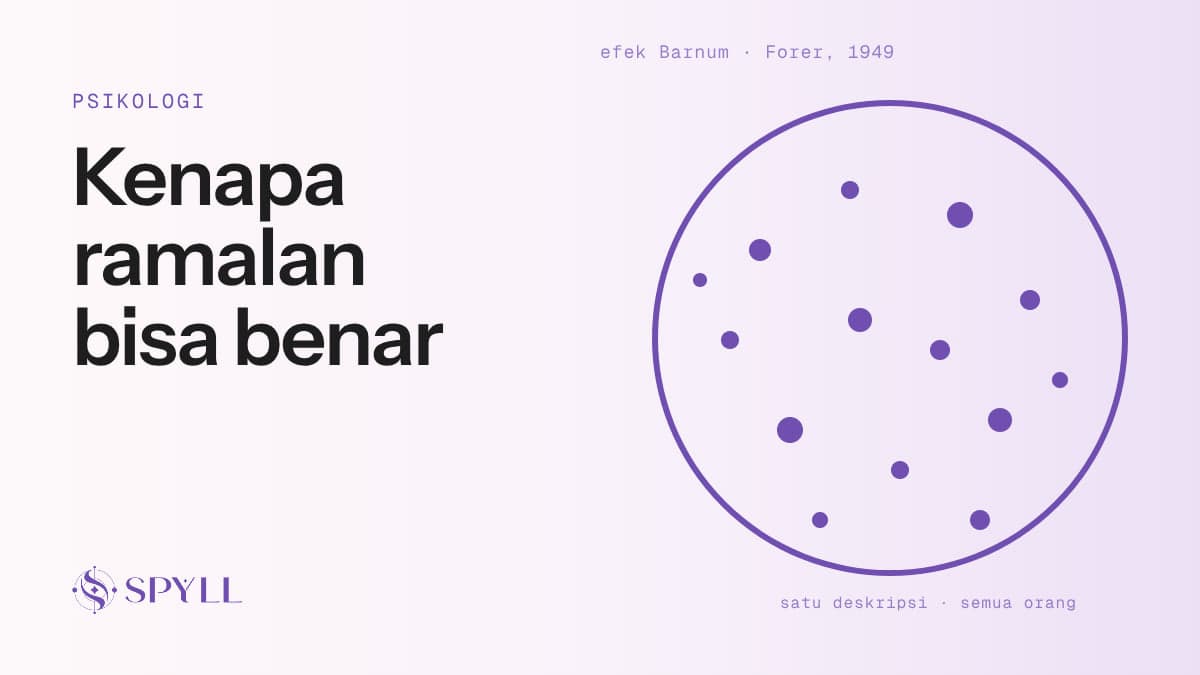
Why do horoscopes seem accurate? Mostly because their lines are written broadly enough to fit almost anyone, which psychologists call the Barnum or Forer effect. Then confirmation bias does the rest: we remember the predictions that landed and forget the ones that missed. A reading written for everyone ends up feeling written for you.
On Quora Indonesia the question shows up as "Apakah kamu percaya pada ramalan zodiak? Kenapa?" ("Do you believe in horoscopes? Why?"). The answers there keep naming the same two things: the Barnum effect and confirmation bias. Both have research behind them that you can check.
Forer's 1948 experiment: one sketch for every student
Psychologist Bertram Forer gave his students a personality test, then handed each one a "personal" result. Every student actually got the same text, which Forer had put together from a newsstand astrology book. Two of its lines, as quoted by The Skeptic's Dictionary:
- "You have a need for other people to like and admire you, and yet you tend to be critical of yourself."
- "Disciplined and self-controlled on the outside, you tend to be worrisome and insecure on the inside."
The students rated how well the sketch described them on a scale of 0 to 5. The average was 4.26. Forer published the result in 1949 in the Journal of Abnormal and Social Psychology as "The fallacy of personal validation".
Read those two lines again. Each names both sides of a trait (wanting admiration yet self-critical, calm outside yet anxious inside), so you can recognize yourself in whichever side you're feeling today. The name "Barnum effect" was popularized by psychologist Paul Meehl in 1956, after the showman P. T. Barnum, whose shows were built to have something for every member of the audience.
When is the Barnum effect strongest?
In 1985, Dennis Dickson and Ian Kelly of the University of Saskatchewan reviewed decades of Barnum research in Psychological Reports. Their main conclusion: people accept a description most readily when it's flattering and when they believe it was made for them specifically.
Horoscopes, zodiac animals, and numerology readings meet both conditions. You type in your own birth date, so the result feels personal. And most readings are pleasant to read: your strengths come first, your weak spots arrive dressed up as "challenges".
Why do horoscopes always seem to come true?
The second half of the answer is confirmation bias. Raymond Nickerson, in a 1998 review in Review of General Psychology, defined it as seeking or interpreting evidence in ways that favor beliefs you already hold.
With horoscopes it goes something like this. Your weekly reading says "news about money is coming this week". On Thursday a friend buys you lunch, and you remember the reading. Monday to Wednesday nothing happened, and you never filed that as a miss. A week later, only the hit is left in your memory.
Loose time frames and wide words ("news", "someone", "a change") let almost any event count as proof. The prediction can never be wrong, and that's exactly why it tells you nothing.
4 ways to test a horoscope or personality reading
You don't have to stop reading horoscopes to dodge the Barnum effect. What changes is how you read them. These four tests work on any reading, from a horoscope to a BaZi report:
- The swap test. Read the entry for someone else's sign, animal, or birth date. If it fits you just as well as your own, the fit comes from general wording.
- The could-be-wrong test. Mark the lines that could turn out false for you, like "you'd rather work alone than in a team". A line that can't be wrong, like "you sometimes doubt yourself", tells you nothing.
- The write-it-first test. Write the prediction down before the week starts, then count the hits and misses honestly at the end. Memory on its own always leans toward the hits.
- The friend test. Ask someone who knows you to rate the reading without telling them it's yours. You tend to judge a reading by who you hope you are, while they see how you behave day to day.
The fourth test touches on blind spots. The people most sure they know themselves aren't always the most accurate, which is the subject of the post on the Dunning-Kruger effect.
What about BaZi, Chinese zodiac, and numerology?
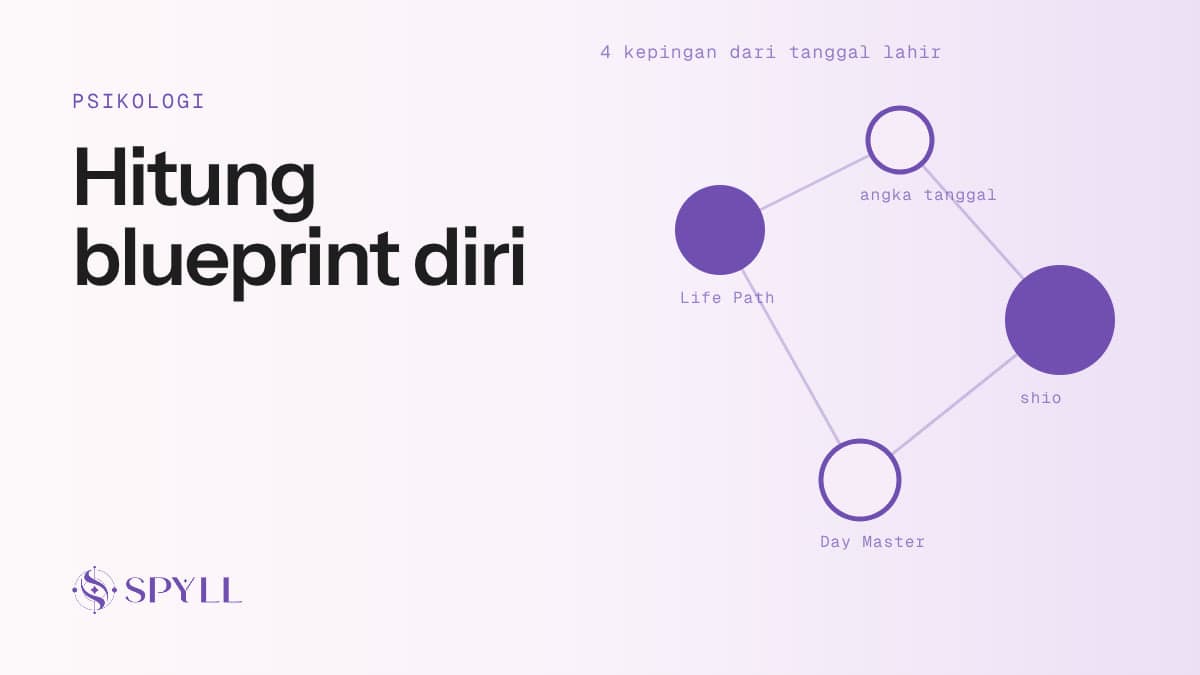
A BaZi or numerology reading has two layers worth separating. The first is the calculation: four pillars from your birth date and time, or a Life Path from the digits of your birthday. That layer is fixed, and anyone can recheck it with the same formula. When I enter January 25, 1999, 10:00 am in Jakarta into the SPYLL BaZi calculator, the day pillar is always 丁丑, whoever runs it and whenever. The steps for working out pieces like this are in how to find your blueprint.
The second layer is interpretation: what a Ding Fire Day Master says about how you work or relate to people. The Barnum effect can get in at this layer, SPYLL's own posts and reports included. That's why SPYLL uses BaZi as a mirror for noticing patterns rather than as fortune-telling, as laid out in why BaZi is pattern recognition, not fortune-telling. How it differs from Western horoscopes is covered in BaZi vs Western astrology.
All four tests apply here as well. The parts of a reading that pass the could-be-wrong test and the friend test are the parts worth using for reflection. If a line stings and you reject it on the spot, note that too, since that reaction sometimes points at a side you aren't ready to look at, which is what Carl Jung's shadow self is about.
When horoscopes meet religious belief
In that Quora thread, one answer discussed horoscopes from an Islamic point of view. Many faiths have their own teaching on fortune-telling, and some people choose not to read horoscopes at all because of what they believe.
This post only covers the psychology: why a reading can feel accurate. Whether and how far to read horoscopes is a matter for your faith, and the question belongs with a teacher or religious leader you trust.
FAQ
What is the Barnum effect?
The Barnum effect, also called the Forer effect, is the tendency to rate a general personality description as an accurate picture of yourself. The classic example is Bertram Forer's 1948 experiment, in which students gave an identical sketch an average of 4.26 out of 5. The effect grows when the description is flattering and believed to be written for the reader.
Does the Barnum effect apply to tarot readings too?
It can, because the conditions are the same: the reading feels personal and its lines can be read in many directions. Use the same tests, especially write-it-first: note what the reading said, then compare it with what happens next. A reading that can't be wrong usually doesn't tell you anything new.
Why do people still believe in horoscopes when they know about the Barnum effect?
Knowing about a bias doesn't make you immune to it. Dickson and Kelly's review found acceptance was highest when a description was flattering and felt personal, and both still work on you after you know the mechanism. Reading horoscopes for fun or as a conversation starter is fine, as long as big decisions don't hang on them.
The most useful reading is one that could be wrong. To try that on yourself, take the SPYLL profiling quiz and read the free chapters with test two: highlight every line that could miss for you, then show only those lines to one close friend and ask which are true. If you'd rather start with the basics, what is self-awareness explains the difference between knowing yourself from the inside and through other people's eyes.
Akhmad Erlangga
· Founder & Framework ArchitectSystems builder focused on personality analytics and self-discovery frameworks. He synthesizes established psychometric models and behavioral dynamics to create structured reflection tools at Spyll.